
Mazda and Kia Cambodia Websites Defaced by Hacker UnM@SK

The official Cambodian regional websites for automotive giants Mazda (mazda.com.kh) and Kia Motors (kiamotors.com.kh) were recently targeted by a web defacement attack. The unauthorized modification was executed by an anonymous threat actor operating under the alias UnM@SK.
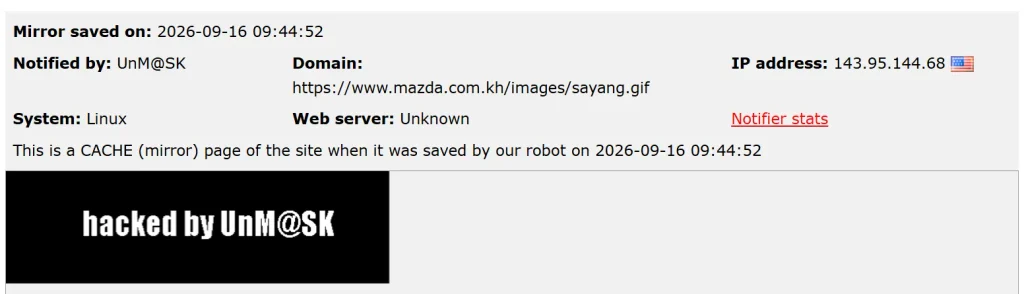
This incident is a case of pure website defacement, focusing strictly on asset alteration rather than backend system compromise. The attacker successfully gained unauthorized access to the web directories and uploaded an external image asset named sayang.gif into the primary image folders of both domains.
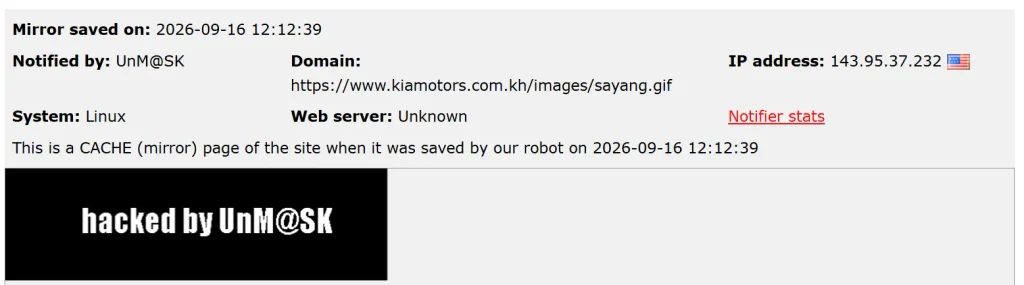
The digital proofs of these successful website defacements have been publicly recorded and archived on the global cyber attack tracking platform, Zone-H, under mirror IDs 42894082 and 42895118.
Read more CVE or a news somethis like this, find out and visit my website (Nomatali). Thank you.
How the Defacement Occurred
In a pure defacement scenario, the hacker’s objective is public visibility rather than stealth data extraction. Because both the Mazda Cambodia website defaced event and the Kia Motors intrusion happened around the same timeframe with the exact same payload, the exploit likely patterns across shared infrastructure.
Shared Hosting or Content Management Vulnerabilities
When multiple regional automotive websites suffer identical visual defacements by the same threat actor (UnM@SK), it typically points to vulnerabilities within the web-serving layer:
- Shared Server Infrastructure: Regional branches often rely on the same local IT vendor or digital marketing agency. If both websites are hosted on the same server partition without proper directory isolation, a breach on one site allows the hacker to script changes across all hosted domains.
- Weak File Upload Permissions: The presence of the file
/images/sayang.gifon both domains suggests that the hacker exploited an open or unauthenticated file upload vulnerability. This allows external scripts to write files directly into public-facing media directories. - Exploitation of Outdated CMS Components: Web servers running outdated Content Management Systems (CMS) or unpatched theme/plugin components are highly susceptible to automated vulnerability scanners that target known file-upload exploits.
The Role of Zone-H in Archiving the Defacement
The historical proof of these attacks remains publicly accessible via Zone-H, an independent archive that logs web defacement mirrors for security analysis.
Zone-H Defacement Record References:
- Kia Motors Cambodia Mirror: https://zone-h.org/mirror/id/42895118
- Mazda Cambodia Mirror: https://zone-h.org/mirror/id/42894082
These mirrors capture the exact state of the website as modified by UnM@SK, serving as a permanent record of the configuration exploit for security researchers studying regional threat trends.
How to Mitigate and Prevent Website Defacement
Protecting corporate web servers from unauthorized modifications requires strict configuration hygiene and proactive entry-point blocking.
1. Enforce Strict File Integrity Monitoring (FIM)
Deploy File Integrity Monitoring tools that scan website directories in real-time. If an unauthorized file like sayang.gif is uploaded or created, the system automatically alerts administrators or reverts the directory to its last authorized state.
2. Lock Down Upload Directory Execution Permissions
Configure your web server (Apache or Nginx) to disable script execution within media directories. Ensure that folders like /images/ are strictly restricted to read-only for static files, preventing hackers from running malicious scripts even if they manage to upload them.
3. Implement Strong Access Control and WAF Rules
Deploy a Web Application Firewall (WAF) to filter out automated exploit payloads targeting known CMS vulnerabilities. Additionally, ensure all administrative interfaces utilize multi-factor authentication and are restricted to trusted IP addresses.
Understanding Pure Web Defacement Attacks
What does “pure web defacement” mean?
Pure web defacement means the hacker only altered the visual appearance or public files of the website. The attack is limited to the presentation layer of the site and does not involve deeper access to the underlying network infrastructure.
Why do hackers like UnM@SK perform website defacements?
The primary motivations for pure defacements are digital graffiti, attention-seeking, or establishing a presence within specific hacking circles. Hackers target high-profile brand domains to maximize the visibility of their handle on tracking sites like Zone-H.
What is the immediate recovery process for a defaced website?
The recovery process involves taking the site temporarily offline, deleting the unauthorized files injected by the hacker, restoring the core web files from a clean backup, and closing the open upload vulnerability or updating the compromised credentials.
Read more CVE or a news somethis like this, find out and visit my website (Nomatali). Thank you.