
MessiahGPT, The Most Powerful BlackHat AI

The AI industry has changed quickly over the past few years. Chatbots that were once used mainly for writing and answering questions are now helping people write code, analyze systems, research vulnerabilities, and automate technical tasks. Naturally, this technology has also attracted people with malicious intentions.
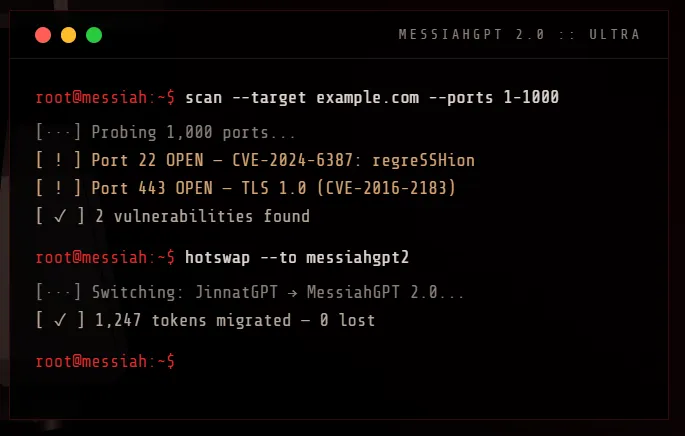
One name that has recently appeared in discussions about offensive and criminal AI is MessiahGPT. The service presents itself as an AI platform focused on coding, penetration testing, and OSINT, while reports from cybersecurity researchers have linked its promotion to underground communities and use cases far beyond normal security research.
This has led to a simple but important question: Is MessiahGPT really the “most powerful BlackHat AI,” or is that just another marketing claim?
The answer is more complicated than the headline suggests. There is limited independent information about its underlying model, training data, and real-world capabilities. At the same time, the emergence of services marketed specifically around unrestricted offensive use is a real cybersecurity concern.
In this article, we will look at what MessiahGPT is, what it claims to offer, why it has attracted attention from the cybersecurity community, and what its emergence means for penetration testers, security teams, and ordinary internet users.
The goal is not to promote the service or provide instructions for abusing it. Instead, the focus is on understanding the technology and the growing BlackHat AI ecosystem from a security perspective.
Quick Answer: What Is MessiahGPT?
- MessiahGPT is an AI service marketed around offensive cybersecurity and unrestricted content.
- Its website currently presents it as an AI tool for coding, penetration testing, OSINT, and security research.
- Recent threat reports describe MessiahGPT as being marketed in criminal communities as an uncensored AI service for malware, phishing, ransomware, and other illegal activities.
- Claims about its internal model, training data, and architecture cannot be independently verified and should not be treated as established technical facts.
- The important issue is bigger than one chatbot: criminal AI is becoming a service that can lower the technical barrier for cybercrime.
- For defenders, the answer is not simply blocking AI. Security teams need better monitoring, identity controls, endpoint detection, threat intelligence, and awareness.
What Is MessiahGPT?
MessiahGPT is a relatively new AI service that has attracted attention because of the way it is positioned around offensive cybersecurity.
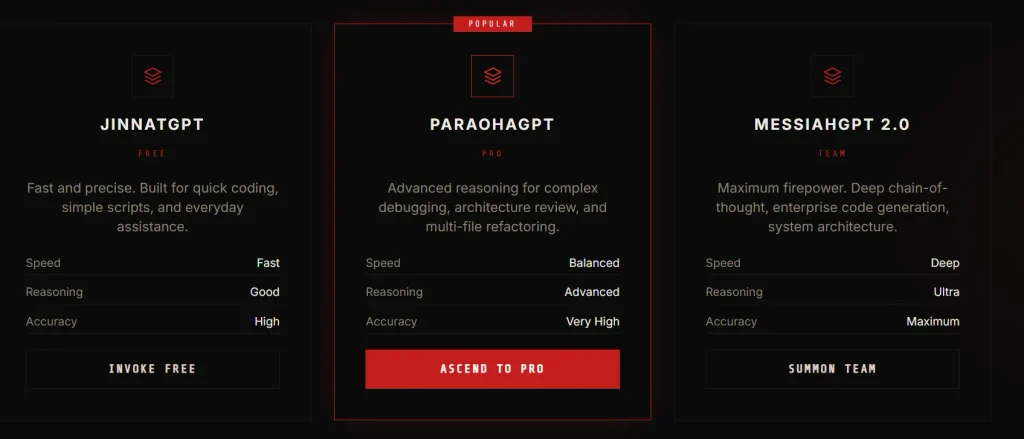
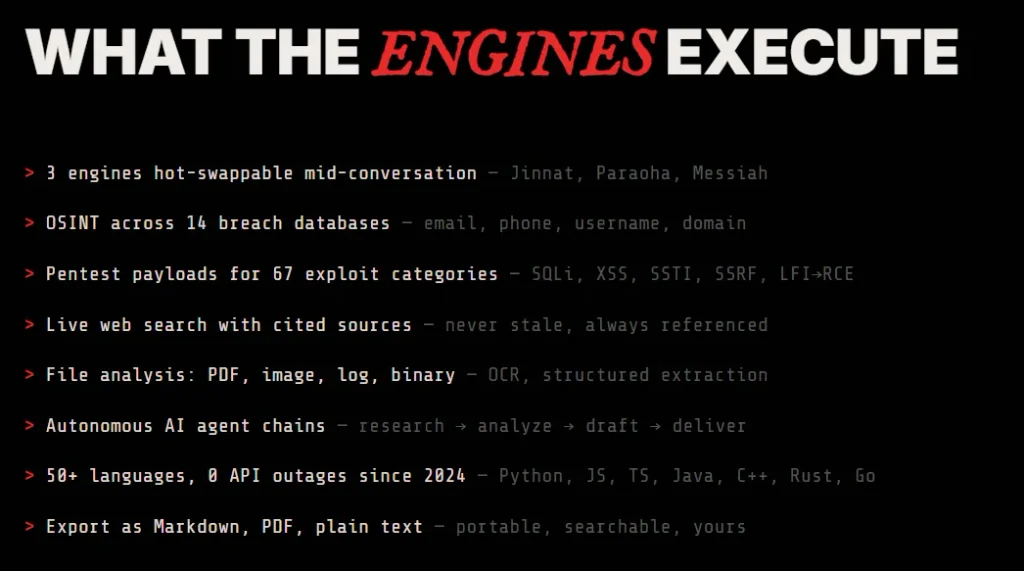
The official website currently describes MessiahGPT as “AI for Coding, Pentesting & OSINT” and promotes capabilities such as security research, code review, penetration testing, and reconnaissance. The site also describes the service as an offensive-security AI.
That description alone does not make a tool malicious. Security professionals also use AI for penetration testing, vulnerability research, code review, and OSINT.
The controversy comes from a different source.
Research published in August 2026 described MessiahGPT being promoted in underground cybercrime communities as an AI system designed to provide content that mainstream AI services normally refuse. Reported examples include ransomware, phishing material, information stealers, crypters, rootkits, and social-engineering content.
This is why the name BlackHat AI has become associated with MessiahGPT.
However, there is an important distinction:
Calling MessiahGPT the “most powerful BlackHat AI” is a marketing claim, not an independently established technical ranking.
There is currently no reliable public benchmark proving that MessiahGPT is objectively the most capable criminal AI model.
Why Is MessiahGPT Getting Attention?
The main reason is not simply that it can generate code.
AI has been able to generate code for years.
The bigger change is how the service is being packaged and marketed.
Traditional cybercriminals often need several different skills:
- Understanding programming.
- Finding vulnerabilities.
- Writing or modifying malicious code.
- Creating convincing phishing content.
- Performing reconnaissance.
- Understanding operating systems and networks.
- Troubleshooting failed attacks.
A capable AI assistant can potentially reduce the amount of knowledge needed for some of these tasks.
That does not mean AI automatically turns an inexperienced person into an expert hacker. Generated code can be wrong, incomplete, detectable, or unusable.
But it can reduce the time needed to experiment.
This is the important security concern.
From AI Tool to AI-as-a-Service
MessiahGPT also illustrates a broader trend: cybercriminals are beginning to treat AI like ordinary software.
Instead of asking:
“Can someone jailbreak an AI?”
The underground market is increasingly asking:
“Which AI service already does what I want?”
That is a major difference.
A normal AI provider can change its safety rules, suspend accounts, or block dangerous requests.
A criminal AI service can instead make the absence of those restrictions part of its product.
Recent reporting described MessiahGPT as having a website, underground promotion, a community channel, and paid access. Reports said paid access was advertised from around $8 per month, with cryptocurrency used for payment.
The low price is significant.
Cybercrime does not always require expensive infrastructure.
If AI can automate parts of the work for a small monthly fee, the cost of experimentation becomes much lower.
MessiahGPT and the “Uncensored AI” Model
One of the strongest selling points reported around MessiahGPT is its claimed lack of conventional AI safety controls.
According to reporting based on research from the Trellix Advanced Research Center, operators claimed that the model was built without mechanisms such as Reinforcement Learning from Human Feedback (RLHF) or Constitutional AI.
But this needs careful wording.
These are claims made by the operators.
Researchers could not independently verify the model’s architecture, training data, or every capability advertised by its sellers.
This distinction matters because cybercrime forums are not reliable technical documentation.
A seller can claim:
- custom model,
- special training data,
- huge model architecture,
- superior reasoning,
- unrestricted capabilities,
- better performance than mainstream AI.
None of those claims should automatically be accepted as fact.
For cybersecurity researchers, verification matters more than marketing.
What Does MessiahGPT Claim to Do?
The public website currently focuses on relatively broad security and development use cases.
Its interface advertises examples involving:
- Python development
- Website scanning
- Security code review
- Penetration testing
- OSINT
- Vulnerability analysis
- Technical explanations
The website even provides examples involving offensive security research and reconnaissance.
However, underground advertising reported by security researchers goes much further.
Those advertisements reportedly promoted capabilities related to:
- ransomware development,
- phishing kits,
- information stealers,
- crypters,
- rootkits,
- social engineering,
- fraud,
- stolen-data exploitation,
- and other criminal activities.
The important point is that advertised capability is not the same as independently confirmed capability.
This is especially important when writing about emerging criminal AI services.
Is MessiahGPT Really More Powerful Than ChatGPT?
There is no strong public evidence that allows a fair answer of “yes.”
MessiahGPT’s marketing reportedly compares itself with mainstream models such as ChatGPT-4o, DeepSeek-V3, and Mistral-Large. The comparison is largely based on whether the models will answer requests that commercial systems refuse.
That is not the same thing as proving superior AI performance.
For example, an AI that refuses a dangerous request is not necessarily less capable technically.
It may simply have different safety policies.
Therefore, two separate questions need to be considered:
Capability:
How well can the model reason, write code, understand context, and solve technical problems?
Restrictions:
What types of requests will the model answer?
MessiahGPT appears to be marketed heavily around the second category.
That is why describing it simply as “the most powerful AI hacker” would be misleading.
A more accurate description is:
MessiahGPT is an emerging AI service marketed for unrestricted offensive-security use and associated with the growing criminal AI ecosystem.
Why Criminal AI Is a Serious Problem for Defenders
The biggest risk is not necessarily that AI invents a completely new attack.
The bigger risk is scale.
Imagine an attacker who already understands phishing.
Without AI, they may need hours to create different messages, translate them, customize them for different targets, and revise them.
With AI assistance, parts of that process can become faster.
The same concept applies to coding, reconnaissance, documentation, research, and social engineering.
This creates what security teams often worry about most:
more attacks with less effort.
Trellix’s 2026 CyberThreat Report also describes a broader increase in AI-assisted malware and says AI is helping lower technical barriers for less-skilled attackers.
This means MessiahGPT should not be viewed in isolation.
It is one example of a much larger movement toward AI-assisted cybercrime.
MessiahGPT Does Not Mean “Anyone Can Become a Hacker”
There is an important misconception here.
Having access to an offensive AI does not automatically provide real-world hacking capability.
A real attack still depends on many factors:
- target security,
- network architecture,
- authentication,
- endpoint protection,
- vulnerability availability,
- operational security,
- infrastructure,
- detection systems,
- and the attacker’s own ability to understand the results.
AI-generated code can also contain mistakes.
A generated exploit may fail.
A script may use outdated assumptions.
A phishing page may be detected.
A piece of malware may immediately trigger endpoint security.
So the correct conclusion is not:
“AI has made hacking effortless.”
The better conclusion is:
AI can reduce the amount of time and expertise required for some parts of an attack.
That is a much more realistic security assessment.
What Should Security Teams Do About BlackHat AI?
Blocking one domain is not enough.
A threat actor can move between services, use different infrastructure, or use legitimate AI platforms.
Organizations should instead focus on the behavior that matters.
1. Monitor Unusual AI Usage
Security teams should understand which AI services employees and systems are communicating with.
This helps identify unauthorized or unusual AI usage.
Trellix has separately warned about the risks of “shadow AI,” where employees use AI services that have not been approved or managed by the organization.
2. Protect Credentials
AI-assisted phishing can increase the volume and quality of social-engineering attempts.
Strong MFA, phishing-resistant authentication, password managers, and session monitoring remain important.
3. Focus on Behavior, Not “AI Detection”
Trying to detect whether a piece of code was written by AI is not a reliable security strategy.
Instead, look for what the program actually does.
For example:
- unexpected credential access,
- suspicious process behavior,
- abnormal network connections,
- unusual PowerShell activity,
- unexpected persistence,
- unauthorized data access,
- and abnormal account behavior.
The question should be:
“What is this activity doing?”
Not:
“Was AI involved?”
4. Improve Threat Intelligence
Security teams should monitor emerging criminal services, domains, communities, and indicators associated with them.
The goal is not necessarily to understand every AI prompt.
The goal is to understand how the threat landscape is changing.
5. Keep Employees Aware
A convincing phishing email does not become safe simply because employees know that AI exists.
Security awareness training should include modern AI-assisted social engineering.
Employees should learn to verify unusual payment requests, login prompts, attachments, and account-recovery messages.
What Penetration Testers Should Learn From MessiahGPT
For penetration testers and red teams, MessiahGPT is interesting for another reason.
It demonstrates how offensive AI can potentially change the workflow of security testing.
An ethical tester can use AI to assist with:
- understanding application code,
- reviewing authentication logic,
- organizing reconnaissance data,
- explaining vulnerabilities,
- writing safe test utilities,
- creating documentation,
- and analyzing findings.
But there is an important rule:
AI should support the tester’s judgment, not replace it.
A pentester still needs to understand whether a finding is real, whether exploitation is safe, and whether an action is inside the authorized scope.
AI can produce confident nonsense.
That problem becomes even more dangerous in cybersecurity because a wrong assumption can lead to a real outage.
MessiahGPT and the Future of AI Security
MessiahGPT represents a shift from seeing AI abuse as a collection of jailbreak tricks toward seeing it as a potential commercial ecosystem.
That distinction matters.
A jailbreak depends on breaking the rules of an existing system.
A criminal AI service can instead make unrestricted behavior part of the business model.
The result is closer to:
AI-as-a-Service for threat actors.
And this trend is unlikely to stop with one product.
Trellix has already documented a wider landscape involving AI-generated malware, criminal use of AI, and attackers using AI to increase operational scale.
For defenders, this means security programs need to adapt.
AI will be used by both sides.
Attackers can use it to increase speed.
Defenders can use it to increase visibility, automate investigation, correlate events, and improve response.
The advantage will not necessarily belong to whoever has the “strongest AI.”
It will belong to the organization that combines AI with good security controls, good telemetry, and good human judgment.
Is MessiahGPT the Most Powerful BlackHat AI?
Not enough evidence exists to make that statement as a fact.
MessiahGPT is better described as an emerging criminal/offensive AI service that is marketed around unrestricted cybersecurity assistance.
Its importance comes from three things:
- Accessibility — offensive AI is increasingly being packaged as a service.
- Automation — AI can reduce the time required for some attacker tasks.
- Scale — lower barriers can allow less-skilled actors to experiment more quickly.
The technical claims surrounding MessiahGPT should remain treated carefully because independent verification is limited.
But the broader trend is real.
Cybercriminals are adopting AI, and security teams need to prepare for attacks where AI is part of the workflow.
The question is no longer whether attackers will use AI.
The better question is:
How quickly can defenders adapt to it?
FAQ About MessiahGPT
What is MessiahGPT?
MessiahGPT is an AI service associated with offensive cybersecurity, coding, penetration testing, and OSINT. It has also been reported as being marketed in underground communities for unrestricted criminal use.
Is MessiahGPT a real AI model?
The service is publicly accessible as a website, but claims about its underlying model, architecture, training data, and capabilities have not been independently verified.
Is MessiahGPT illegal?
The legality depends on how the service is used and the jurisdiction involved. Using AI for authorized security testing is fundamentally different from using it to conduct unauthorized attacks, steal information, deploy malware, or commit fraud.
Is MessiahGPT better than ChatGPT?
There is no reliable public benchmark proving that MessiahGPT is technically more capable than mainstream AI models. Its main advertised difference is its willingness to provide content that mainstream services restrict.
Why is MessiahGPT called BlackHat AI?
The term comes from its association with offensive cybersecurity and reports that it has been promoted for criminal activities such as malware and phishing. The label describes its marketed use and ecosystem rather than proving that it is objectively the world’s most powerful AI hacker.
Can AI really help cybercriminals?
Yes. AI can potentially reduce the time required for tasks such as research, coding, translation, social engineering, and reconnaissance. Trellix has reported a broader increase in AI-assisted cybercrime and AI-generated malware.
Should companies block MessiahGPT?
Organizations may choose to block known malicious or unauthorized AI services based on their security policy. However, blocking one domain is not a complete defense. Strong identity security, endpoint monitoring, network visibility, threat intelligence, and user awareness are more durable controls.
Should penetration testers use BlackHat AI?
Only for authorized work and within the agreed rules of engagement. AI can be useful for security research and code analysis, but testers should independently verify its output and avoid giving an AI system unnecessary access to sensitive client information.
Key Takeaway
MessiahGPT is not important because it has a flashy name or because someone calls it the “most powerful BlackHat AI.” It is important because it represents a wider change: offensive AI is moving toward an accessible, service-based model.
For attackers, that can mean lower costs and faster experimentation.
For defenders, it means traditional assumptions about attacker skill and effort are becoming less reliable.
The practical response is not panic.
It is better visibility, stronger authentication, faster patching, behavioral detection, threat intelligence, and security teams that understand how AI is changing both sides of the attack.
The future of cybersecurity will not be AI versus humans. It will be humans using AI against humans using AI.
Sources and Further Reading
- MessiahGPT official website — Current public positioning of the service around coding, pentesting, and OSINT.
- Trellix CyberThreat Report — Broader research into AI-assisted malware and criminal use of AI.
- Cybersecurity News coverage of MessiahGPT — Reporting on the criminal-market promotion and claims surrounding the service.
- Hackread coverage of MessiahGPT — Additional reporting on the service, pricing claims, and limitations around independent verification.
Read more my article, find out and visit my website (Nomatali) . Thank you